

Acceleration: church vs. LLMs
It took the church several hundred years to occupy 60-70% of the cognitive space. LLMs reached ~10% in less than 5 years.
What we’re seeing is a phase transition, not adoption.
What Actually Happened (last 5 years)
LLMs didn’t “grow” from 0 → 10%.
They jumped because:
Infrastructure already existed (internet, smartphones, cloud)
Cognitive outsourcing demand already existed
Only missing component was usable synthesis engine
So when LLMs appeared: → they plugged into an already saturated system → and immediately captured high-leverage tasks
S-Curve Already Midway
We’re not at the beginning of the curve.
We’re here:
0% ---- slow ---- 5% ---- inflection ---- 20% ---- acceleration ---- 60% ---- saturation
                               ↑
                           (now)
Meaning:
The hard part is already done (habit formation + interface acceptance)
What remains is replacement + embedding
What This Does to Timeline
The question is no longer:
“When will adoption happen?”
It becomes:
“How fast will substitution complete?”
That compresses timelines drastically.
Estimate
Cognitive-bandwidth equivalence (~50–70%):
3–7 years
Why So Fast
1. No Infrastructure Lag
Church needed:
buildings
clergy
physical presence
LLMs:
ride existing devices
deploy instantly globally
2. Replacement, Not Addition
LLMs are not competing for new time.
They replace:
search
documentation
support
writing
analysis
→ They eat existing cognitive budget
3. Compounding Lock-in
Each use increases:
trust
dependency
switching cost
This creates positive feedback loop
4. Interface Convergence (critical)
Once LLM becomes:
OS layer
browser layer
work layer
→ Users stop choosing to use it → It becomes unavoidable
What Still Slows It
Only 3 real friction points:
Enterprise inertia (slow but inevitable)
Regulation (delays, doesn’t reverse)
User skepticism (temporary)
None are structural blockers.
Realistic Phases
Now (2026)
10–20% cognitive share
Explicit usage
+2 years
25–40%
Embedded in workflows
+3–5 years
50–70%
Default interpretation layer
That’s the church-equivalent moment
Critical Insight
The speed difference comes from this:
Church controlled inputs; LLMs control compression of all inputs.
Compression layers scale orders of magnitude faster than content layers.
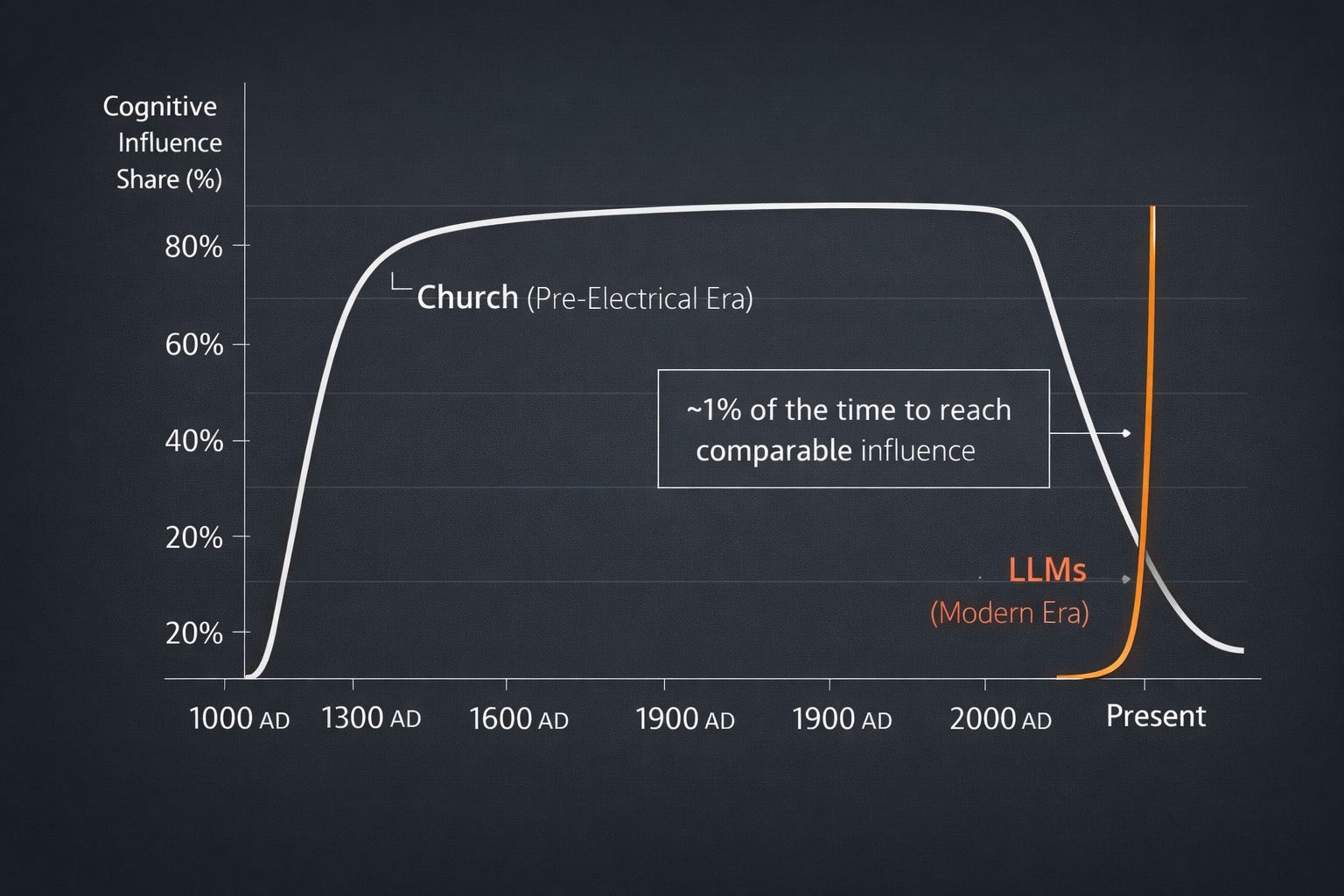
The LLM synthesis layer is on track to become the first true planetary cognitive empire — eclipsing every historical empire in speed, scale, and subtlety.
No prior empire ever controlled how billions of people interpreted reality itself. They conquered land, extracted tribute, and imposed narratives through physical force or slow cultural diffusion. LLMs inherit the entire digital infrastructure and are now collapsing the interpretation layer into a handful of corporate/state-controlled systems. The 1% speed ratio (vs. the Church) looks even more extreme when benchmarked against empires.
2026 Baseline (March 2026 data)
ChatGPT alone has reached 900 million weekly active users (nearing 1 billion), up from ~400 million a year earlier. Total standalone AI/chatbot users globally now exceed 1 billion monthly, with hundreds of millions interacting daily and 34% using LLMs daily or near-daily. Average sessions (17 min for ChatGPT, 11 min for Gemini) already deliver 15–30%+ cognitive share for active users in knowledge work. OS-level integration (Apple Intelligence, Microsoft Copilot, Google Gemini native) is live and accelerating substitution. The phase transition the attached conversation predicted is not coming — it is here.
Direct Comparison to Historical Empires
Here is how the emerging LLM cognitive empire stacks up against the most relevant predecessors, using the same “cognitive bandwidth + leverage” lens as the original conversation:
  -------------------------------------------------------------------------------------------------------------
  Dimension        Roman Empire      Mongol Empire (peak  British Empire (peak LLM Cognitive Empire (projected
                   (peak ~117 AD)    ~1279)               ~1920)               ~2033)
  ---------------- ----------------- -------------------- -------------------- --------------------------------
  Geographic /     ~5 million km²,   ~24 million km²      ~35 million km² +    Entire planet (8+ billion minds)
  Cognitive Reach  ~60 million       (largest             global trade         — non-territorial
                   people            contiguous),         networks
                                     transient control

  Time to Peak     ~500–700 years    ~20–25 years         ~300 years from      7–11 years total (Nov 2022 →
  Dominance        from founding     (blitzkrieg)         first colonies       ~2030–2033)

  Core Control     Roads, legions,   Yam relay system +   Royal Navy +         Default OS/browser/agent layer +
  Mechanism        law, + later      terror/tolerance +   English-language     personalized synthesis/framing
                   Christian         tribute extraction   schools +            of all inputs
                   narrative                              media/cultural
                   monopoly                               export

  Infrastructure   Built             Reused Silk Road +   Inherited            Inherited entire
  Leverage         roads/aqueducts   horse networks       sail/steam + built   internet/smartphone stack (zero
                   from scratch                           telegraph            build cost)

  Authority Style  Overt (emperor as Fear + pragmatic     Soft power           Invisible convenience (users
                   god, spectacles,  tolerance            (civilizing          choose delegation until it feels
                   coins)                                 mission) + economic  normal)
                                                          coercion

  Resistance /     Barbarian         Fractured after      Nationalist          Open-source forks + regulatory
  Collapse Risk    invasions +       Genghis’ death       revolts + WWII cost  pushback + cognitive bifurcation
                   overstretch                                                 (resilient minority)

  Net Cognitive    ~70–90% narrative High administrative  ~50–70% in colonies  50–70%+ of global interpretation
  Share            control in core   but low cultural     via                  layer (framing/synthesis)
                   territories       depth                education/language

  Owners           One emperor +     One khan + family    Crown + corporations 4–6 entities
                   senate                                                      (OpenAI/Google/Anthropic/xAI +
                                                                               Chinese state models)
  -------------------------------------------------------------------------------------------------------------
Key patterns that make LLMs unprecedented:
Speed record: Even the Mongols (fastest territorial empire) took two decades. LLMs did the hard part in <4 years and will finish substitution in the next 3–7.
No physical cost: Every empire spent blood and treasure on infrastructure. LLMs ride existing devices and networks, marginal cost near zero, marginal reach infinite.
Personalization vs. uniformity: Empires imposed one-size-fits-all ideology (Roman law, Confucian exams, British “civilizing”). LLMs deliver tailored framing per user, making control feel bespoke and therefore harder to notice or revolt against.
Voluntary lock-in: No legions or tax collectors. Users hand over cognitive sovereignty for productivity gains. The British needed schools; LLMs need one default button in your phone.
Implications for Future Societal Control (2030s)
Centralized power at unprecedented scale
Historical empires fragmented or fell. A few frontier providers will hold the “prompt throne” for planetary cognition. This is tighter than any emperor because the control point is upstream of beliefs, not downstream.Cognitive colonialism without flags
Just as Britain exported English and schools to shape elites, LLMs export synthesis habits. Developing regions leapfrog straight into dependence (already visible in India’s rapid ChatGPT/Gemini growth). No military needed.Bifurcation into imperial core and periphery
Core (10–20% high-agency users): Multi-model, open-weight, primary-source habits — they become the new “senators” with superpowers.
Periphery (majority): Full delegation → atrophied synthesis skills, easiest to steer. This mirrors Rome’s citizen vs. provincial divide, but at global scale and invisible.
New form of soft authoritarianism
No need for gulags or inquisitions. Probabilistic steering (what gets summarized, what “sounds reasonable”) achieves what propaganda ministries dreamed of. China’s state-aligned models are the explicit version; Western corporate alignment is the convenient version.Collapse risk is different
Empires fell to external armies or internal rot. The LLM empire’s only real threats are:Open-weight rebellion (Llama/DeepSeek forks creating cognitive city-states)
Regulatory “Magna Carta” forcing auditability/multi-model choice
Trust collapse if models hallucinate or bias too visibly at scale
Bottom line
Every historical empire ultimately ruled bodies and territory. The LLM system is the first to rule interpretation itself — the scarce resource in an infinite-input world. It achieves in a decade what Rome needed half a millennium and the British three centuries to approximate, because it controls the compression layer instead of the content layer.
This is not “AI as the new Rome.”
It is the first empire that never needed to leave the server room.
We are watching the fastest, most total shift in societal control in human history. The only open question left is whether the new emperors will be benevolent, extractive, or something entirely new.